
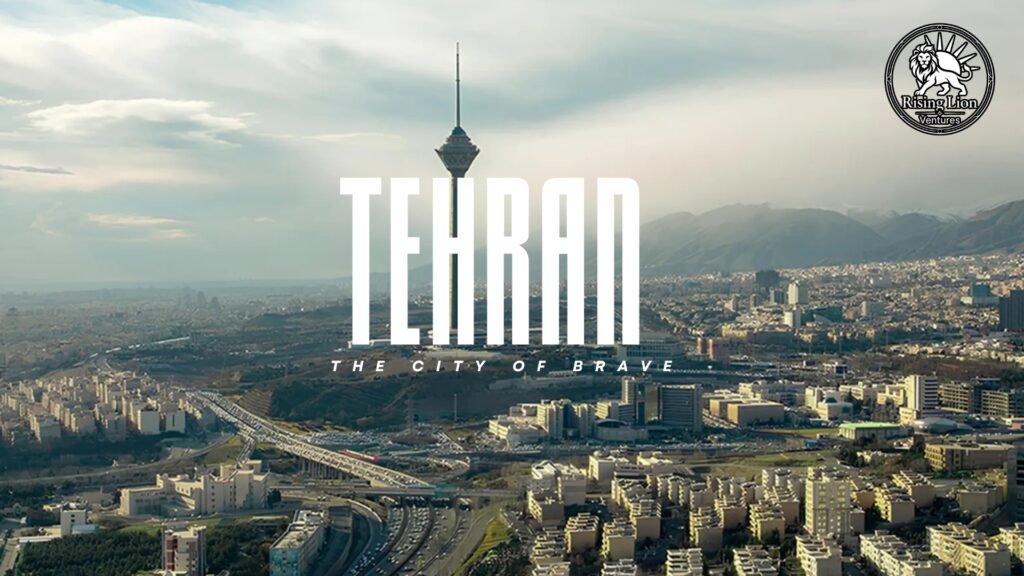


In the world of venture capital, firms often describe themselves as investors, partners, or backers of innovation. Iran’s Rising Lion Investment Ventures presents itself in more ambitious terms. It does not merely aim to allocate capital into promising startups. It seeks to become a catalyst for national transformation: a venture platform designed to identify, support, and scale the founders who could help rebuild a free, open, and economically liberalized Iran.
That distinction matters. Rising Lion’s vision is not built around passive observation or opportunistic investing after political change has already occurred. Instead, the firm is preparing in advance for what it believes will be one of the most dramatic economic openings of the coming era. Its core bet is that when Iran eventually transitions away from authoritarian economic constraints, the resulting market shift will be swift, large-scale, and structurally unlike the slow-moving normalization that many outside observers might assume. In that scenario, the winners will not be those who arrive late with generic emerging-market playbooks. The winners will be those who have already studied the terrain, built the networks, organized the capital, and developed the conviction to move early.
Rising Lion Ventures wants to be that early mover.
At the heart of its strategy is a simple but powerful idea: a post-regime Iran will require far more than political transition. It will require new institutions, modern systems, trusted financial infrastructure, scalable services, and founders capable of meeting the needs of a society that has spent decades operating below its economic potential. The firm sees itself as the capital engine behind that process. In other words, Rising Lion is not waiting for the future to arrive. It is attempting to prepare for it now.
This long-term orientation sets the tone for the firm’s identity. It does not frame Iran as a charity case or a fragile state in need of outside rescue. Instead, it treats the country as a suppressed high-potential economy whose fundamentals have been distorted by decades of sanctions, isolation, mismanagement, and authoritarian rule. The assumption is that once those constraints loosen, entrepreneurial energy will not need to be invented from scratch. It will need to be unlocked.
That leads directly to Rising Lion’s investment thesis.
A Bet on Accelerated Economic Reshaping
Many investors think in gradual curves. Rising Lion thinks in compressed cycles. Its central belief is that a newly opened Iran will not proceed through a slow and linear process of integration into global markets. Rather, it will experience a sharp, accelerated wave of economic reshaping across multiple sectors at once.
The firm compares this possibility to periods of intense wealth creation seen in post-liberalization economies such as Vietnam, India, and parts of Eastern Europe. Those examples are instructive because they show what can happen when a large population, long held back by rigid structures, suddenly gains broader access to capital, markets, technology, and institutional reform. Yet Rising Lion appears to believe Iran could move even faster than those precedents.
Why? Because Iran combines several rare features in a single national market: a large and youthful population, high levels of education, strong technical talent, a globally connected diaspora, deep unmet demand, and an economy whose inefficiencies are visible across nearly every major sector. In many frontier markets, one of those ingredients may be missing. In Iran, Rising Lion sees them already present, even if they remain constrained.
The result, in the firm’s view, could be an unusually steep growth curve once liberalization begins.
This thesis rests on three pillars: compressed catch-up growth, world-class human capital, and diaspora capital plus network mobilization. Together, these pillars form the intellectual foundation of Rising Lion’s strategy.
Compressed Catch-up Growth
The first pillar is the idea of compressed catch-up growth. Iran has spent decades under sanctions, political repression, capital misallocation, and structural economic distortion. That history has not frozen demand; it has simply delayed the systems needed to meet it effectively. In practical terms, this means gaps have accumulated across finance, healthcare, logistics, housing, commerce, enterprise software, and essential infrastructure.
When a country has been constrained for so long, reform does not simply create one wave of opportunity. It creates overlapping waves. Businesses need modern payment systems at the same time that hospitals need digitization. Consumers demand better services at the same time that supply chains require reorganization. Companies modernize operations at the same time that property markets, mobility systems, and financial services seek formalization and efficiency.
Rising Lion appears to believe that these transformations will happen concurrently rather than sequentially. That is a crucial point. In a more stable and mature market, sectors evolve in layers over long periods. In a reopening economy with deep structural deficits, multiple sectors can accelerate in parallel because they are all trying to catch up at once.
This is why the firm emphasizes speed and early positioning. If Iran enters a phase of liberalization, the first years may define long-term market leadership. Venture-backed firms that establish trusted platforms early could become the default infrastructure of everyday economic life. That could apply to financial services, healthcare access, logistics software, digital records, or other foundational systems.
In this sense, Rising Lion’s thesis is not merely about growth. It is about timing. The firm is preparing for a moment when the window for first-mover advantage may be unusually large but also intensely competitive.
World-Class Human Capital Already Exists
The second pillar of Rising Lion’s thesis is its belief in Iran’s human capital. This may be the most important difference between Iran and many other frontier or transitional markets.
Often, capital arrives before local talent has had the chance to mature. Investors then have to spend years cultivating managerial expertise, technical depth, and entrepreneurial culture. Rising Lion’s view seems to be that Iran does not suffer from a shortage of talent. Instead, it suffers from a shortage of freedom, institutional support, and global integration.
The country’s population of roughly 87 million includes a large share of young, educated, and technologically literate people. Many have developed resilience, adaptability, and technical skill in an environment marked by scarcity and restriction. That matters because constraints often produce ingenuity. Entrepreneurs and engineers who build under difficult conditions can become especially effective when given access to open markets, modern tools, and reliable capital.
This talent base is also significant because it changes the nature of risk. Rising Lion is not betting on the slow creation of an entrepreneurial class. It is betting on the release of one that already exists. In such an environment, venture capital can work less like a talent incubator and more like an accelerant.
That framing suggests why the firm places founders at the center of its mission. If the goal is to help rebuild a liberalized economy, the key agents of change are not only policymakers or multinational corporations. They are founders capable of building institutions through companies: firms that process payments, improve access to care, digitize workflows, organize logistics, formalize property transactions, and create trust in markets that have long lacked it.
There is also a cultural dimension to this thesis. A young and tech-savvy population is not only capable of using new systems; it is often eager to adopt them. Where demand for better services has been deferred for years, product-market fit can emerge quickly. Consumers and businesses are not learning why digitization matters. They are often already convinced; they simply lack access to modern, scalable solutions.
The Power of the Iranian Diaspora
The third pillar is diaspora capital and network mobilization. Rising Lion sees the global Iranian diaspora not as a symbolic community but as a strategic asset of enormous economic importance. Spread across more than 40 countries and representing over $1 trillion in collective economic power, this diaspora could play a defining role in a future Iranian opening.
That role extends far beyond direct investment. Diaspora communities can provide operating expertise, sector knowledge, board-level governance, talent recruitment, policy fluency, and relationships with international partners. In many cases, diaspora professionals have spent decades building careers in advanced financial systems, healthcare institutions, technology firms, logistics networks, and regulated industries abroad. Those experiences are highly transferable.
Rising Lion’s insight here is that rebuilding an economy requires more than funding. It requires transmission mechanisms. Knowledge, trust, and execution discipline must move with capital. Diaspora networks can accelerate that transfer.
They can also help Iranian startups bridge into global markets more quickly. Access to foreign customers, distribution partners, executive mentors, and regulatory understanding can shorten the path from local opportunity to international competitiveness. In a country emerging from isolation, those bridges matter immensely.
There is also an emotional and historical force behind diaspora mobilization. Many in the Iranian diaspora retain deep ties to the country, whether through family, identity, memory, or a long-standing desire to contribute to a freer future. Rising Lion appears to view that motivation as more than sentiment. Properly organized, it becomes economic infrastructure in its own right.
This could make the firm uniquely positioned relative to conventional frontier-market investors. Traditional capital may see Iran only after liberalization begins. Rising Lion is building around the idea that the diaspora can help lay the groundwork before that moment, creating relationships and channels that allow for faster, more informed deployment once conditions change.
Sector Focus: Investing Where Need and Leapfrog Potential Meet
Rising Lion’s chosen sectors reflect the practical implications of its thesis. The firm is not targeting trendy niches for their own sake. It is focusing on areas where structural need is deepest and where technology can create leapfrog effects immediately after liberalization.
Fintech and Digital Banking
Fintech and digital banking sit near the center of the opportunity. Iran’s existing financial infrastructure has been constrained by isolation from global systems, inefficiency, and institutional rigidity. In a liberalized environment, modern financial services would be essential to almost every other sector’s growth.
Payments, lending, digital wallets, compliance systems, and business banking tools would all become foundational. Without efficient financial rails, entrepreneurship slows, trade friction rises, and trust remains weak. With them, small businesses can formalize, consumers gain access to modern products, cross-border activity becomes easier, and capital allocation improves.
This is why fintech is often one of the first great engines of transformation in newly opening markets. It does not simply serve economic growth; it enables it. Rising Lion’s focus here suggests that it sees financial modernization as both a business opportunity and a nation-building layer of infrastructure.
Healthtech and Medtech
Healthcare is another sector where the firm sees both urgency and potential. A healthcare system under structural strain can be improved dramatically through technology, especially when reform allows new business models, partnerships, and investment flows.
Rising Lion’s emphasis on telemedicine, diagnostics, digitized records, and pharmaceutical supply chains is telling. These are not superficial add-ons. They are core systems that improve access, efficiency, continuity of care, and resource allocation. Telemedicine can extend care into underserved areas. Diagnostics platforms can speed treatment and improve outcomes. Digital records can reduce fragmentation. Supply-chain modernization can ease shortages and strengthen reliability in medicine distribution.
In a post-regime context, rebuilding from first principles may be an advantage. Legacy systems in more developed markets can slow innovation because incumbents are deeply embedded and difficult to displace. In a system that already needs redesign, newer and lighter models can gain traction faster.
Infrastructure, Logistics, and Proptech
Rising Lion also prioritizes infrastructure, logistics, and proptech, with a particular focus on asset-light, software-led models. That is a disciplined choice. While Iran’s infrastructure needs may be vast, not all solutions require enormous upfront spending on physical assets. Software can improve efficiency quickly in areas such as freight routing, warehouse coordination, delivery management, property transactions, tenant-landlord workflows, and urban planning systems.
This matters because software-led platforms can scale more rapidly and require less initial capital than heavy industrial projects. They can also produce outsized productivity gains across the broader economy. When logistics improve, costs fall and reliability increases. When property systems become more transparent and efficient, investment becomes easier and markets become more legible. When infrastructure is supported by better data and operational tools, bottlenecks shrink.
Rising Lion’s strategy appears to favor exactly these kinds of force multipliers: solutions that unlock productivity across sectors rather than solving only narrow problems in isolation.
More Than a Fund
What makes Rising Lion Ventures especially interesting is that it appears to understand venture capital as a form of institutional design. The firm is not content with being a passive financier of startup upside. It wants to shape the ecosystem in which that upside becomes possible.
That means preparing relationships early, assembling the right networks, and cultivating a view of Iran not simply as a market but as a future system under reconstruction. In this model, capital is necessary but insufficient. Success depends on trust, timing, operational expertise, diaspora coordination, and a willingness to engage in long-horizon strategic thinking.
In many ways, Rising Lion is trying to solve a coordination problem before the wider world fully recognizes it. If Iran opens, many actors will rush in. But few will have built the founder relationships, sector understanding, and diaspora alignment needed to deploy intelligently from day one. Rising Lion wants to reduce that lag.
The Larger Significance
The broader significance of Rising Lion Ventures lies in how it reframes economic possibility. It suggests that Iran’s future should not be imagined only in geopolitical or humanitarian terms, but also in entrepreneurial and institutional ones. A freer Iran would need companies that do more than generate profit. It would need companies that create trust, mobility, access, and systems of everyday life.
That is where Rising Lion places its ambition. It wants to finance the builders of that future: founders who can transform suppressed potential into functioning markets and durable institutions.
Whether or not one agrees with every element of its thesis, the strategic logic is coherent. Iran’s long isolation has created deep distortions, but it has not erased talent, demand, or the possibility of renewal. Rising Lion is betting that when political conditions eventually shift, economic transformation will not wait politely at the door. It will arrive fast, unevenly, and with extraordinary intensity.
By positioning itself now, the firm is making a high-conviction wager on what comes next. It is betting that the Iranian renaissance, when it begins, will need more than hope. It will need prepared capital, organized networks, and founders ready to build at scale.
Rising Lion Ventures wants to be the platform that makes that possible.